Kilmainham Gaol is not a lighthearted tourist attraction. It is a cold, imposing, and deeply somber site that serves as the physical epicenter of Ireland’s struggle for independence. Between its opening in 1796 and its closure in 1924, this limestone prison held ordinary citizens driven to crime by the Great Famine, alongside the political leaders of almost every major Irish rebellion.
Today, it is one of Dublin’s most visited historical sites. Because of its popularity and strict capacity limits, getting inside requires planning. You cannot simply walk up to the gate and buy a ticket.
This guide breaks down exactly how to secure entry, what to look for in the architecture, and how to navigate the site without feeling rushed.
Kilmainham Gaol is run by the Office of Public Works (OPW). Official tickets are released exactly 28 days in advance at midnight (Dublin time) and sell out almost immediately for the summer months.
If you miss out on official tickets, you can still dive into this era of Irish history by booking the 1916 Rising Walking Tour and GPO Museum Entry, which covers the same historical figures and events.
Why Kilmainham Gaol Matters
To understand Dublin, you have to understand the 1916 Easter Rising. And to understand the Easter Rising, you have to stand in Kilmainham Gaol.
Following the failed rebellion against British rule in April 1916, fourteen leaders of the uprising were brought to Kilmainham, court-martialed, and executed by firing squad in the Stonebreaker’s Yard. Prior to the executions, the Irish public was largely indifferent or even hostile to the rebels, viewing them as troublemakers who destroyed the city center. However, the drawn-out, secretive nature of the executions at Kilmainham shifted public sympathy entirely, effectively sparking the Irish War of Independence.
Beyond 1916, the gaol is a monument to the Great Famine (1845–1852). During this period, the prison was drastically overcrowded with men, women, and children who committed petty crimes—like stealing food—specifically to be arrested, as prison guaranteed a basic ration of food.
5 Architectural & Cultural Highlights
The mandatory guided tour moves at a steady pace. Knowing what to look for ahead of time helps you absorb the details without falling behind your group.
1. The Victorian East Wing (The Panopticon)
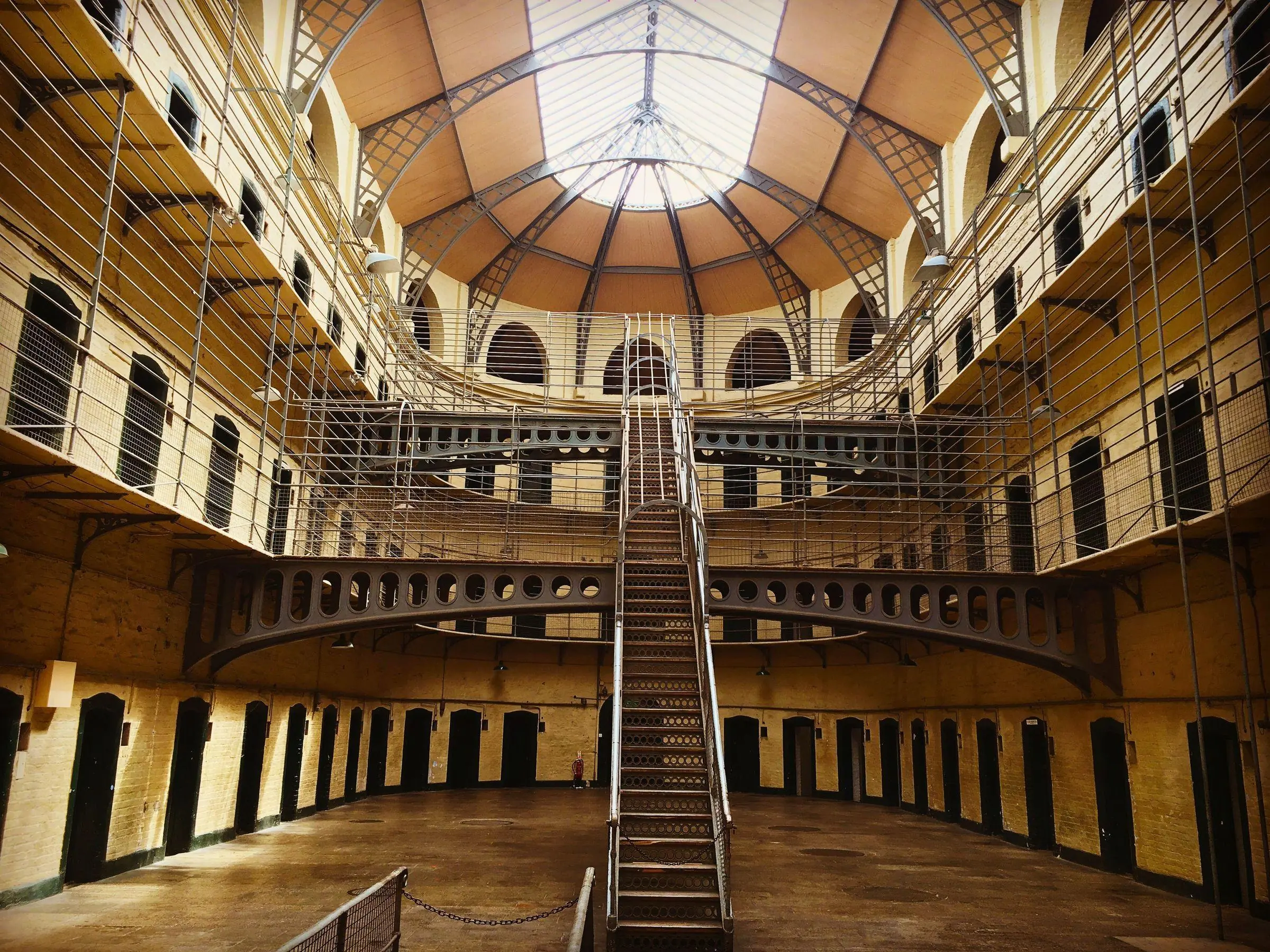
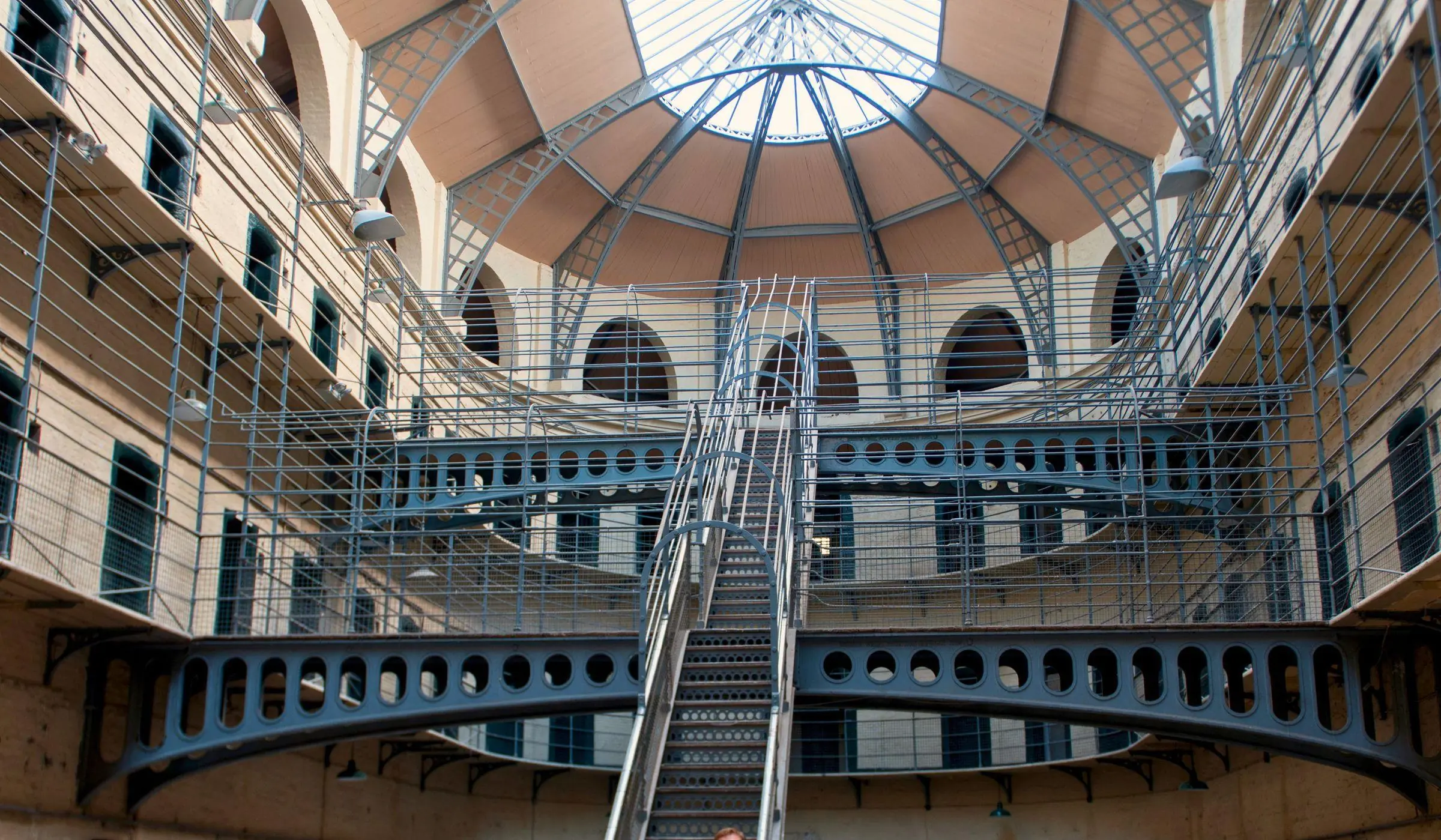
Added in 1862, the East Wing is the most visually striking part of the prison and the area you have likely seen in photographs or films (like The Italian Job or In the Name of the Father). It was built based on the “panopticon” principle, a Victorian architectural concept designed for constant surveillance.
- What to look for: Notice the central staircase and the metal walkways. A single guard standing in the center of the floor could see the doors of all 96 cells simultaneously. The massive glass skylight was intended to provide “heavenly light” to encourage prisoner repentance, but it also made the wing freezing in winter and stifling in summer.
2. The Stonebreaker’s Yard
This high-walled, gravel courtyard was originally where prisoners were sentenced to hard labor, breaking large stones into gravel for road building. In May 1916, it became the execution site for the leaders of the Easter Rising.
- What to look for: Look for the two simple black crosses at opposite ends of the yard. One marks where 13 of the men were shot. The other, at the far end, marks where James Connolly was executed. Because Connolly was severely wounded in the fighting and unable to stand, he was tied to a chair to face the firing squad.
3. The West Wing (The Old Prison)
In stark contrast to the bright East Wing, the West Wing dates back to the prison’s opening in 1796. The corridors are narrow, dark, and damp. This section housed many of the leaders of the 1798, 1803, 1848, and 1867 rebellions.
- What to look for: Above the heavy wooden cell doors, you will see the names of famous political prisoners who were held there, including Charles Stewart Parnell and Eamon de Valera. Notice the lack of glass in the windows; prisoners were exposed to the elements year-round.
4. The Kilmainham Courthouse
Before entering the prison itself, your tour will likely begin in the adjoining Kilmainham Courthouse. Built in 1820, this is where many prisoners received their sentences before being walked directly next door to the gaol.
- What to look for: The original judge’s bench and the holding pen in the center of the room. The acoustics here are excellent, designed so the judge’s voice would carry a tone of absolute authority.
5. The Asgard Exhibition (Museum)
After your guided tour of the prison concludes, you are free to explore the three-story museum at your own pace. The top floor houses the Asgard exhibition.
- What to look for: The Asgard was a yacht used in 1914 to smuggle 900 rifles and 29,000 rounds of ammunition into Ireland for the Irish Volunteers. The actual restored boat is on display here, taking up an entire room.
Navigating Tickets & Tours
Access to the prison cells and the Stonebreaker’s Yard is strictly by guided tour only. You cannot wander the prison independently. The adjoining museum is self-guided, and you can spend as much time there as you like after your tour.
How to Get Tickets (The 28-Day Rule)
Tickets are sold exclusively through the official Heritage Ireland website. They are released exactly 28 days in advance at midnight (Irish Standard Time). If you are visiting between May and September, tickets for popular times (10:00 AM to 2:00 PM) will sell out within hours of release.
Ticket Options & Logistics
OPW Guided Tour
- Mandatory 60-minute guided tour of the prison.
- Unlimited time in the self-guided museum.
- Must be booked 28 days in advance.
1916 Rising Walking Tour
- Best alternative if Kilmainham is sold out.
- Explores the city-center battlegrounds of the Easter Rising.
- Includes entry to the GPO Museum.
The 9:15 AM Cancellation Hack
If you failed to book 28 days out, there is one reliable local hack. The OPW processes cancellations every morning. Log onto the official ticketing website exactly at 9:15 AM (Dublin time) on the day you want to visit. Any returned tickets for that day are released back into the system. You have to be quick, but this is how many locals secure last-minute entry.
Should you book a third-party tour?
- Some private tour companies buy bulk tickets and bundle them with city walking tours.
- Can be a lifesaver if official tickets are sold out.
- You are paying a massive markup (often €40-€60) for an €8 ticket.
- The third-party guide cannot guide you inside the prison; they hand you over to the OPW guide at the door.
Audience Segmentation: How to Plan Your Visit
For the Time-Poor: Allocate exactly two hours. The guided tour takes 60 minutes. You will want 45 minutes for the museum and 15 minutes for security and bathroom breaks. If you are on a tight schedule, take a taxi rather than the bus, as traffic on the quays can delay public transit.
For Families with Children: Kilmainham Gaol is a dark, cold environment focused on execution, starvation, and imprisonment. It is highly educational for teenagers, but children under 8 may find it boring or frightening. Strollers are not permitted on the guided tour due to narrow staircases, though they can be left at the reception desk.
For Budget Travelers: At €8, this is one of the best value historical sites in Europe. If you are a student, bring your physical student ID to get the discounted €4 rate.
Keep Planning: If you are interested in the history of the 1916 Rising, pair your visit with the GPO Museum on O’Connell Street, which served as the rebel headquarters.
Getting There (Logistics)
Kilmainham Gaol is located about 3.5 kilometers (2.2 miles) west of Temple Bar. Walking takes about 45 minutes, so most visitors use transit.
By Hop-On Hop-Off Bus: This is the easiest option for tourists. Both major sightseeing buses stop directly outside the gaol. The DoDublin Hop-On Hop-Off Bus (the green buses) and the Big Bus tours drop you at the gates.
By Luas (Light Rail): Take the Red Line Luas from the city center (Abbey Street or Jervis stops) westbound toward Tallaght or Saggart. Get off at the Suir Road stop.
- Walking directions from Luas: Exit the tram, cross the Grand Canal, and walk straight down Davitt Road. Turn right onto Suir Road, then take a left onto South Circular Road. The gaol will be on your right. It’s a 10 to 12-minute walk through a quiet residential area.
By Dublin Bus: Take Route 13 or 40 from O’Connell Street or College Green. Get off at the Inchicore Road stop (Stop 1940). The bus drops you less than a 5-minute walk from the entrance. Use your Leap Card for the cheapest fare.
Local Tips
- Dress warmly: The prison was built without heating and retains a deep, damp chill year-round. Even if it is 20°C (68°F) and sunny outside, you will need a sweater or light jacket inside the West Wing.
- Arrive 15 minutes early: If you miss your tour slot, you will not be accommodated on the next one. The OPW is incredibly strict about this due to fire safety capacities.
- Eat beforehand: There is a small café on-site (The Patriot’s Inn is also across the street), but food is not allowed inside the gaol.
- Bag restrictions: There are no lockers on site, and large backpacks or suitcases are not permitted on the tour. Travel light. If you have luggage, use a luggage storage service in the city center before heading out.
Where to Stay Nearby
Kilmainham is a quiet, residential neighborhood. Staying here gets you out of the noisy city center while keeping you close to the Gaol, the Irish Museum of Modern Art (IMMA), and Phoenix Park. It is well-connected to the center via the Luas Red Line.
Frequently Asked Questions
Can I visit Kilmainham Gaol without a guided tour?
No. Access to the prison cells and the Stonebreaker’s Yard is strictly by guided tour only. You cannot walk through the prison independently. However, the museum exhibition is self-guided.
How long does the Kilmainham Gaol tour take?
The guided portion of the tour lasts exactly 60 minutes. You should allow an additional 45 to 60 minutes to explore the self-guided museum afterward.
Is Kilmainham Gaol wheelchair accessible?
Partially. The museum, the ground floor of the East Wing, and the Stonebreaker’s Yard are accessible. However, the older West Wing features narrow corridors and steep staircases that are not accessible to wheelchair users.
Are tickets available at the door?
Almost never. During the summer months, tickets sell out weeks in advance. Occasionally, there are no-shows, but relying on walk-up tickets is highly risky. Always book online in advance.
Is the tour suitable for young children?
It depends on the child, but generally, it is not recommended for toddlers or very young children. The content focuses heavily on execution, starvation, and harsh prison conditions. Furthermore, strollers cannot be taken on the tour due to narrow stairs.
What happens if I am late for my tour slot?
You will likely be denied entry. The OPW operates on strict capacity limits, and tours leave exactly on time. Aim to arrive at the courthouse entrance at least 15 minutes before your scheduled time.
Next Steps: After exploring Kilmainham, take a 15-minute walk to the nearby Irish Museum of Modern Art (IMMA), housed in the stunning 17th-century Royal Hospital, or head back to the city center to visit Dublin Castle.