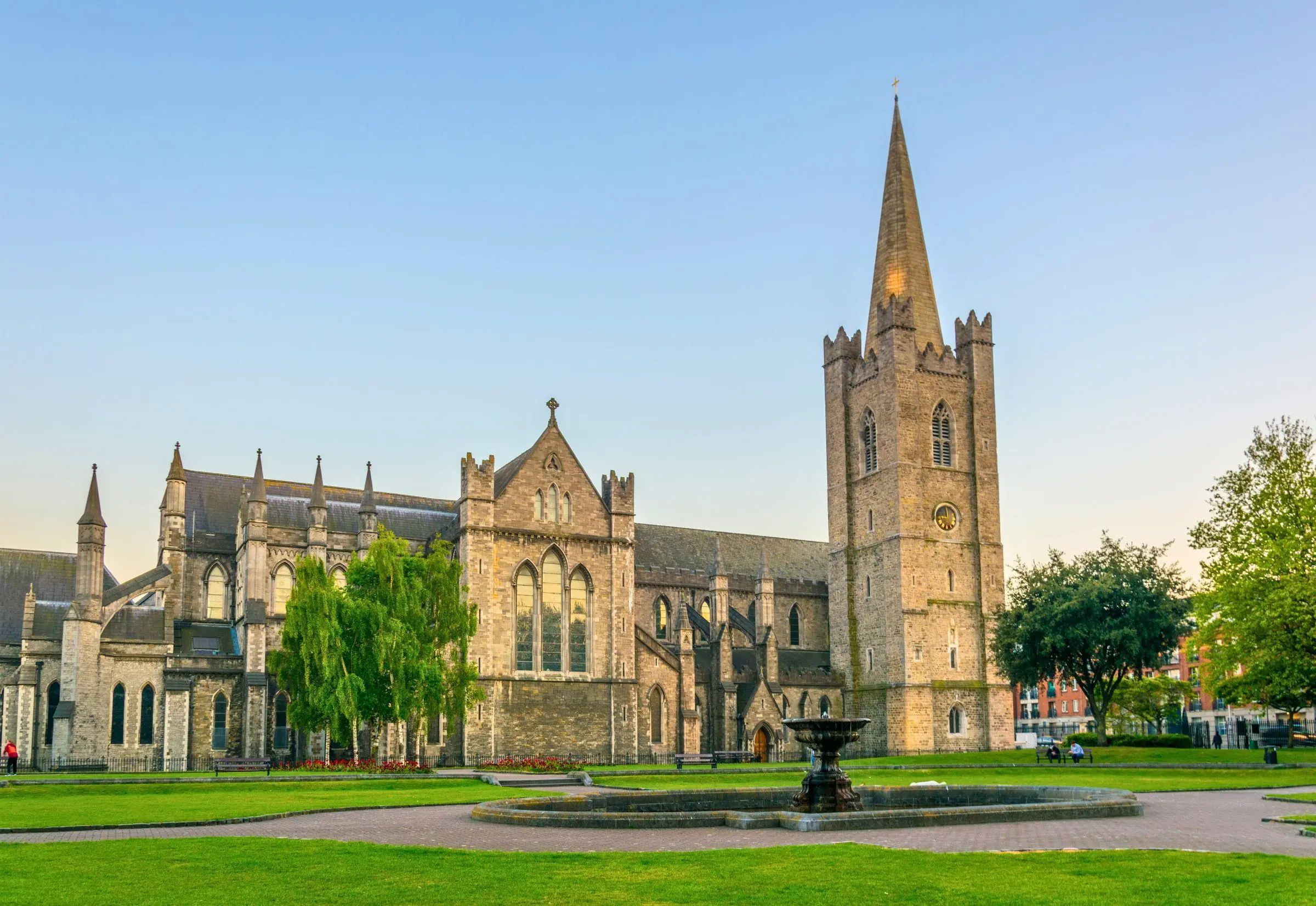
St Patrick’s Cathedral stands on the site where Saint Patrick himself is said to have baptized Christian converts at a local well over 1,500 years ago. Today, the current building—dating back to 1191—is the largest cathedral in Ireland and serves as the National Cathedral of the Church of Ireland.
Unlike many European cathedrals that function primarily as quiet places of worship, St Patrick’s is a busy, multi-layered historical site. It holds the graves of prominent historical figures, displays centuries of military and civic banners, and features a layout that tells the story of Dublin’s turbulent religious and political history.
Because it sits just outside the immediate medieval city walls (a short walk from Christ Church Cathedral), it draws massive crowds, particularly from coach tours between 11:00 AM and 2:00 PM. This guide breaks down exactly how to navigate the building, what to look for, and which entry tickets make the most sense for your trip.
Who Should Visit (And How)
Different travelers have different constraints. Here is how to approach St Patrick’s Cathedral based on your travel style:
- The Time-Poor Traveler: If you only have 45 minutes, book a skip-the-line entry ticket in advance. Focus entirely on the Nave, Jonathan Swift’s grave, and the Door of Reconciliation. Skip the detailed audio guide and read the primary informational placards instead.
- Families with Children: The cathedral itself can test the patience of young children, but the adjacent St Patrick’s Park is one of the best enclosed green spaces in central Dublin. Grab a coffee from a nearby cafe on Patrick Street, let the kids run around the park, and then do a brisk 30-minute walk-through of the cathedral.
- The Budget Traveler: If you want to experience the cathedral without paying the tourist entry fee, you can attend a scheduled service. Choral Evensong (usually held at 5:30 PM on weekdays) is free to attend and allows you to hear the world-famous choir. Note: You cannot walk around and take photos during a service; you are there to observe or participate in worship. If you plan to visit multiple sites, check if the Dublin Pass saves you money.
While you can buy tickets at the door, the queue often stretches down the steps and onto the pavement during the summer months. Booking ahead saves you standing in the elements. Get Entry Tickets
5 Architectural & Cultural Highlights
St Patrick’s is dense with monuments, plaques, and architectural details. If you wander aimlessly, it all blends together. Here is a deep-dive into the five specific things you should actively look for.
1. Jonathan Swift’s Grave and Epitaph
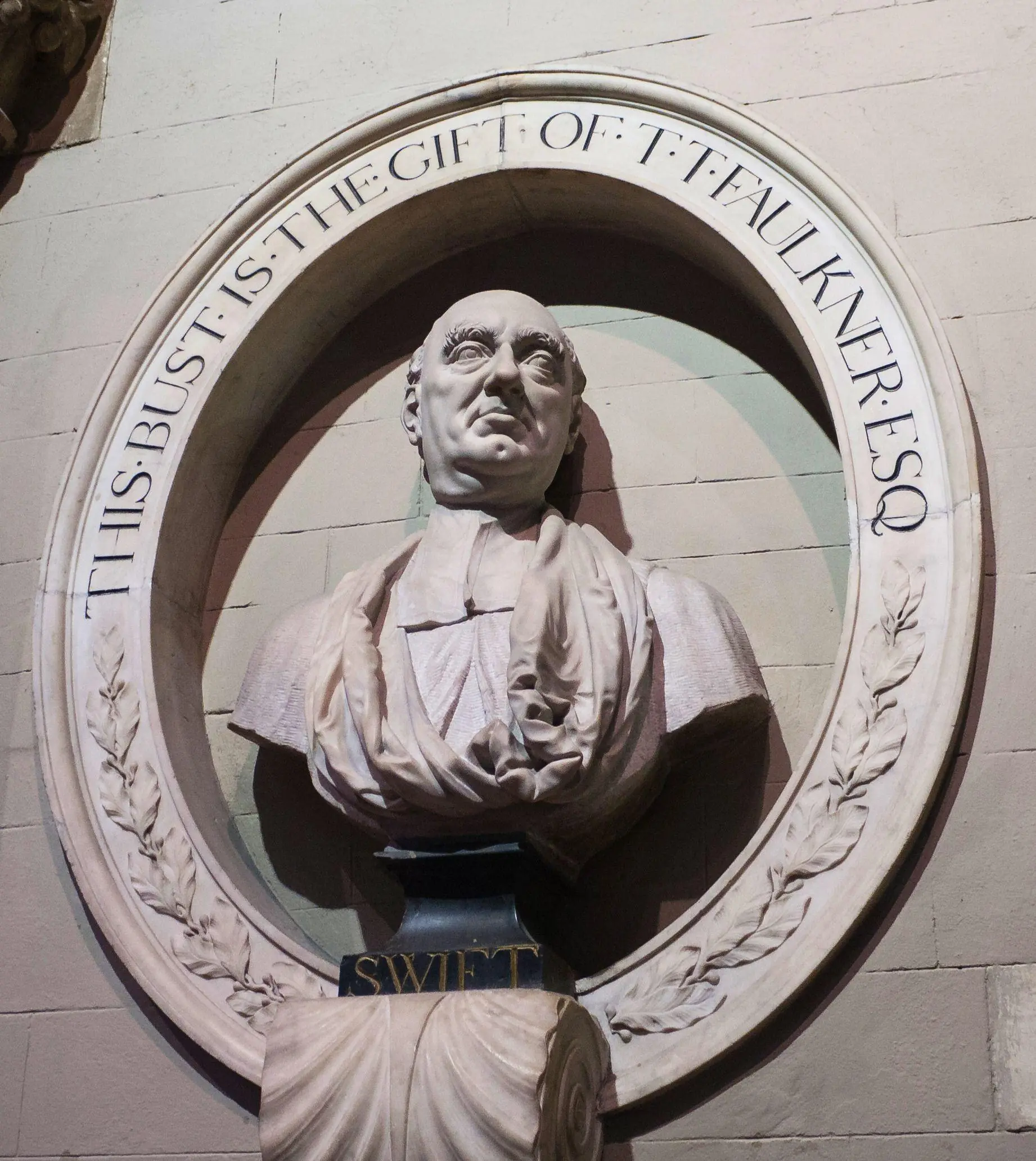
Jonathan Swift, the author of Gulliver’s Travels, was the Dean of St Patrick’s Cathedral from 1713 to 1745. He was a fierce defender of Irish rights and a brilliant satirist. He is buried in the floor of the cathedral alongside his long-time companion, Stella (Esther Johnson).
Look for his self-penned epitaph on the wall nearby, written in Latin. Translated by W.B. Yeats, it reads in part: “He has gone where fierce indignation can lacerate his heart no more.” Nearby, you’ll also find a dedicated Swift corner featuring a cast of his skull, his death mask, and a selection of his early published works.
2. The Door of Reconciliation
This is arguably the most famous wooden door in Ireland. In 1492, two feuding Irish families—the Butlers of Ormonde and the FitzGeralds of Kildare—clashed in Dublin. The Butlers took refuge inside the Chapter House of St Patrick’s Cathedral.
To end the bloodshed, Gerald FitzGerald ordered a hole chopped into the heavy wooden door. He then thrust his arm through the hole to offer a handshake of peace to the Butlers inside, risking his arm being hacked off. The Butlers accepted the handshake, ending the feud. This event is the origin of the common English phrase “to chance your arm.” The original door is on display in the north transept.
3. The Choir and the Knights of St Patrick
As you walk toward the altar, you will enter the Choir. Look up. Hanging above the intricately carved wooden stalls are the colorful banners, swords, and helmets of the Knights of the Order of St Patrick.
This chivalric order was founded by King George III in 1783. The stalls were assigned to the knights, and their heraldic banners remain suspended in the vaulted ceiling. The woodwork here is exceptionally detailed, and this is where the cathedral choir sits during daily services.
4. The Lady Chapel
Located at the very eastern end of the cathedral (behind the main altar), the Lady Chapel was built in 1270. It was used as a church for French Huguenot refugees from 1666 to 1816.
Architecturally, it is a stunning example of Early English Gothic style, featuring delicate, slender columns and high vaulted ceilings. It was heavily restored in the 19th century (funded by the Guinness family, who effectively saved the cathedral from collapse), but it remains one of the quietest and most atmospheric sections of the building.
5. The Father Willis Organ
St Patrick’s houses one of the largest and most impressive pipe organs in Ireland, built by Henry Willis & Sons in 1902. It contains over 4,000 pipes. If you visit during choir practice or a service, the acoustics of the 300-foot-long nave amplify the organ’s sound in a way that vibrates through the stone floor.
Keep Planning: If you are fascinated by Dublin’s medieval religious history, you should also read our guide to Christ Church Cathedral, located just a 10-minute walk away.
Ticket Options: Independent vs. Guided
You have a few ways to access the cathedral. Here is a breakdown of the most common entry passes and tours.
Standard Admission Ticket
- Skip the ticket purchasing line at the door.
- Includes access to the entire cathedral floor.
- Explore at your own pace (typically 45–60 minutes).
- Does not include a live guide.
St Patrick's, Book of Kells & Dublin Castle
- 2.5-hour guided walking tour.
- Includes fast-track entry to St Patrick’s Cathedral.
- Includes entry to the Book of Kells and Dublin Castle grounds.
- Excellent for history buffs wanting context.
The Dublin Pass
- Includes entry to St Patrick’s Cathedral.
- Grants access to 40+ other attractions (Guinness, Jameson, etc.).
- Includes a 1-day Hop-on Hop-off bus ticket.
- Only worth it if doing 3+ major sites per day.
The Verdict: Do You Need a Guide?
Independent vs Guided Visit
- Independent: Cheaper, allows you to move at your own pace, and you can read the excellent informational placards throughout the nave.
- Guided: A guided tour connects the dots between St Patrick’s, Dublin Castle, and Trinity College, giving you a cohesive narrative of Dublin’s history.
- Independent: You might miss the subtle details (like the translation of Swift’s epitaph) without someone pointing them out.
- Guided: Expensive, locks you into a strict schedule, and you can’t linger in the Lady Chapel if the group moves on.
Logistics & Transit Directions
St Patrick’s Cathedral is located in Dublin 8, bordering The Liberties neighborhood. It is slightly south of the main Temple Bar tourist drag, but easily accessible.
- Walking: It is a 10-minute walk south from Christ Church Cathedral, or a 15-minute walk from Temple Bar. The walk down Patrick Street is flat and straightforward.
- Luas (Tram): Take the Green Line to the St Stephen’s Green stop. From there, it is a 10-minute walk west along Cuffe Street and Kevin Street.
- Bus: Dublin Bus routes 49, 54a, 56a, 77a, and 150 all stop directly outside the cathedral on Patrick Street.
- Hop-On Hop-Off: All major sightseeing buses have a dedicated stop right at the cathedral gates.
Accessibility: The main floor of the cathedral is fully wheelchair accessible. However, some of the side chapels have slight lips or uneven medieval stone flooring. Accessible toilets are available on-site.
Local Tips for Avoiding Crowds
- Beat the Coaches: The cathedral is swamped by large coach tour groups between 11:00 AM and 2:00 PM. To experience the building in peace, arrive right when it opens (usually 9:30 AM) or visit after 3:30 PM.
- The Park Hack: If you arrive and the queue to get in is massive, don’t stand in line. Grab a coffee at the Tramyard nearby, sit in St Patrick’s Park, and wait 20 minutes. The line moves in waves based on when tour buses drop off.
- Photography: The cathedral interior is quite dark, and tripods are generally not allowed without prior permission. If you want a great exterior shot, the best angle is from the fountain in the center of St Patrick’s Park, looking east toward the spire.
- Combined Tickets: If you plan to visit both cathedrals, there is no official “dual ticket” discount anymore. You must buy St Patrick’s tickets and Christ Church tickets separately.
Where to Stay Nearby
The area immediately surrounding St Patrick’s Cathedral (The Liberties and Portobello) is an excellent place to base yourself. It is slightly cheaper than Temple Bar, packed with great local cafes, and within walking distance of major sites like the Guinness Storehouse and Teeling Distillery.
Frequently Asked Questions
How much time do I need to visit St Patrick's Cathedral?
Most visitors spend between 45 minutes and 1 hour inside the cathedral. If you are reading every plaque and visiting the Lady Chapel, allow for 75 minutes.
Is there a dress code for visiting the cathedral?
There is no strict dress code enforced for tourists, but it is an active place of worship. Modest dress is appreciated (avoiding overly revealing clothing), and men are generally expected to remove hats upon entering.
Can I attend a church service for free?
Yes. The cathedral holds daily services, including a beautiful Choral Evensong on most weekdays. Entry for worship is free, but you cannot walk around the cathedral to sightsee or take photographs during the service.
What is the difference between St Patrick's and Christ Church Cathedral?
Christ Church is older (founded 1030) and features a massive medieval crypt. St Patrick’s is larger, features more extensive grounds (the park), and is heavily associated with Jonathan Swift. Both are Church of Ireland (Anglican) cathedrals.
Are there guided tours available inside?
The cathedral occasionally offers free volunteer-led tours throughout the day, but they are subject to staff availability and cannot be booked in advance. For a guaranteed guide, you must book an external guided walking tour.
Is Jonathan Swift actually buried there?
Yes. Jonathan Swift and his companion Stella are buried side-by-side under the floor of the nave. Their graves are marked by brass plaques in the floor, and Swift’s famous epitaph is on the adjacent wall.
Ready to explore Dublin's history?
Secure your entry to St Patrick’s Cathedral in advance to skip the ticket queue and guarantee your spot.